
The orchestration platform for your contingent workforce
Upplft provides the control layer modern organisations need to run contingent talent as a single workflow, not a set of disconnected tools.
.webp)
Upplft’s capabilities work together across the contingent workforce lifecycle - integrating where systems already exist, and orchestrating where cost and compliance break down.
What sets us apart
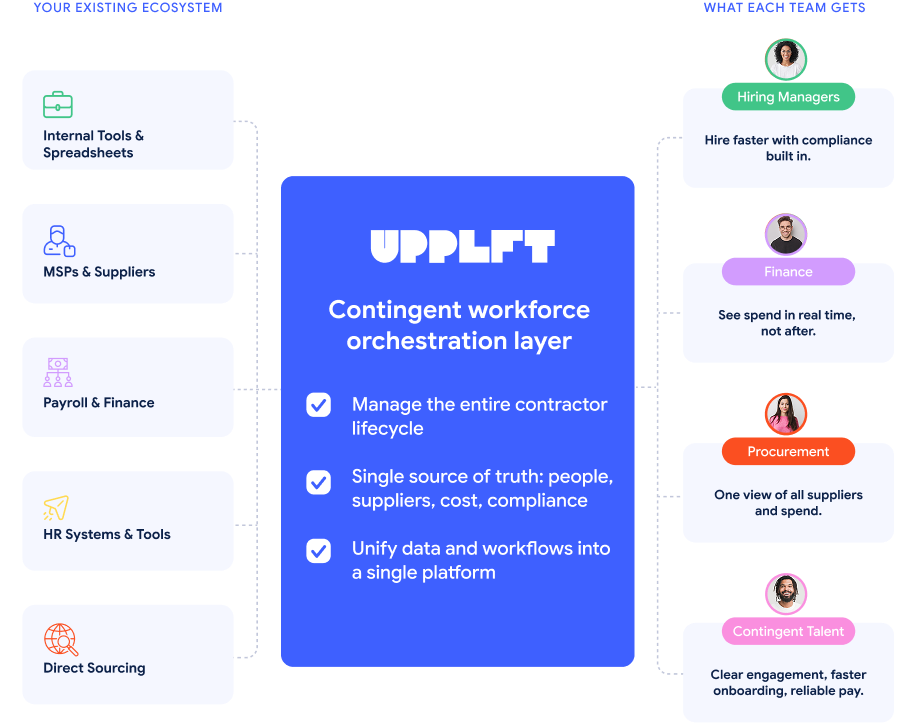
Orchestrates your existing stack, without replacing it
Upplft doesn't replace your MSP, VMS, or payroll platform. It brings them together, providing a single source of truth and governance across the entire contingent lifecycle.
Cost and compliance are built into the process
Prevent cost leakage before it happens. Approval workflows, rate controls, and compliance requirements are built into the process, giving Finance instant visibility and every team a governed way to work.
Purpose-built for contingent workforce
Most workforce platforms were built for permanent hires. Upplft supports the complexity of contingent work across engagement types, supplier relationships and jurisdictions.
The contingent workforce operating system
Upplft’s capabilities work together across the contingent worker lifecycle - integrating where systems already exist, and orchestrating where cost and compliance break down.
One system of record for contingent workers
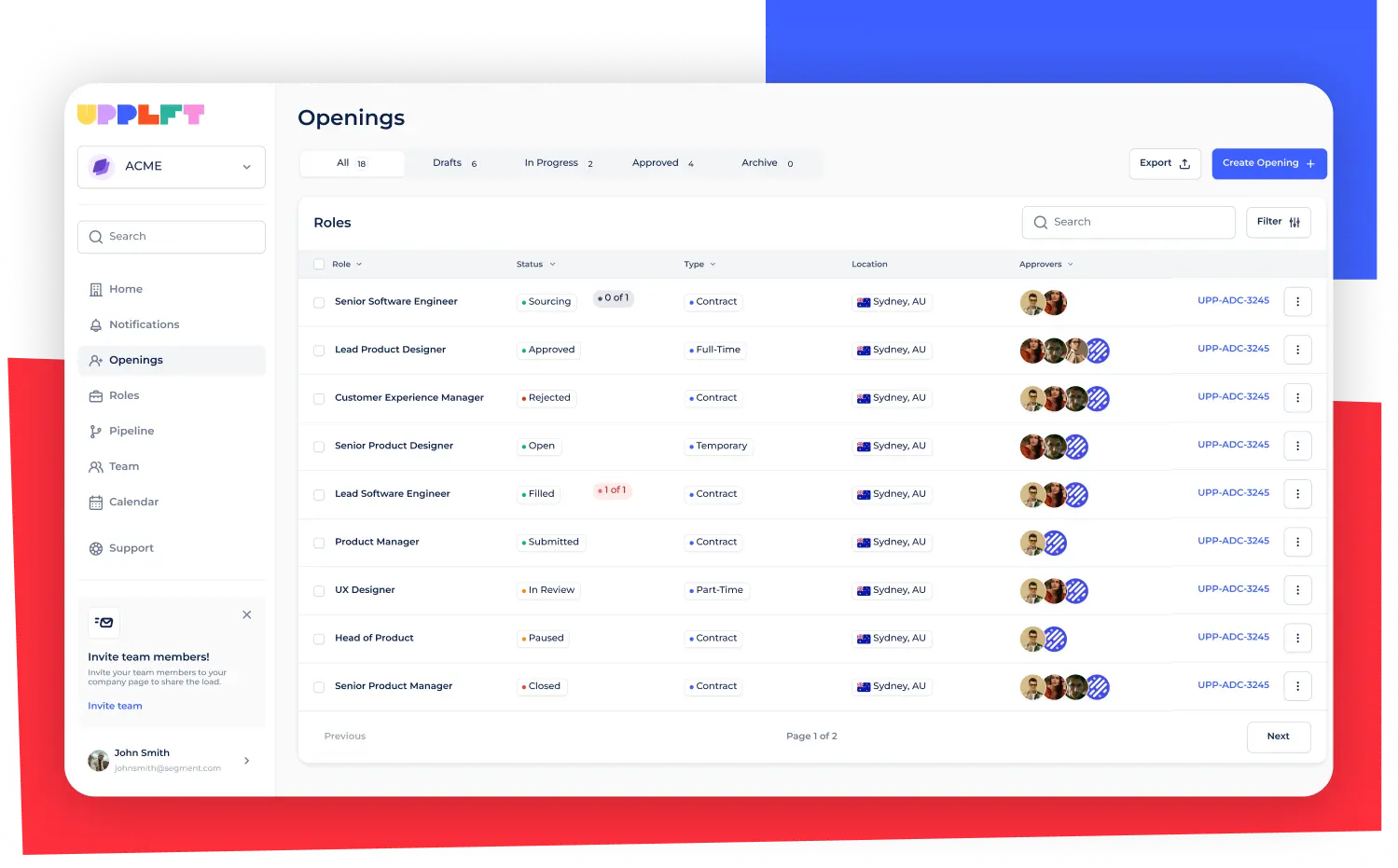
Unify HR, VMS, payroll and supplier systems into a single source of truth across regions and business units.
Contractor management: A system of record for contingent workers.
Talent pool: Structured communities for re‑engagement, redeployment, and continuity.
Candidate pipeline: Visibility across contingent demand and supply.
Financial reporting: Aligned cost and workforce data in one place.
Real-time visibility into cost and risk
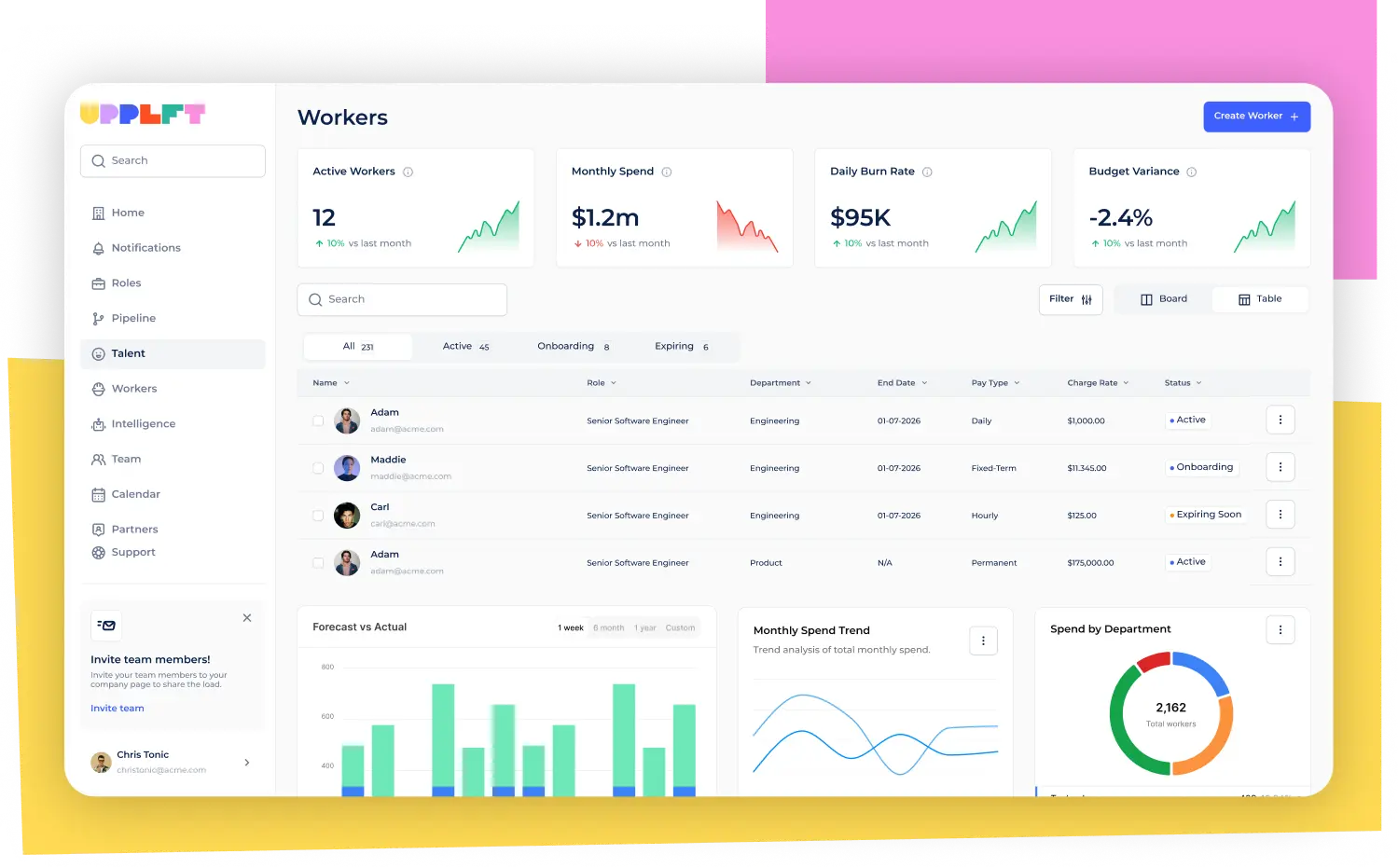
See spend, supplier performance, compliance exposure and workforce mix in real time, before costs are committed.
Financial reporting & insights: Unified cost and spend visibility across the lifecycle.
Workforce mix analysis: Understanding contingent vs permanent balance.
Supplier performance tracking: Evidence-based optimisation across partners.
Compliance status visibility: Real-time risk awareness across regions and engagement types.
Manager self-service: Guided, compliant interactions with full audit trail.
Supplier & contractor experience: Clear, transparent participation across the platform.
.webp)
Governed control across the hire-to-pay lifecycle
Standardise how contingent work is requested, approved, onboarded and paid, across every team and region.
Hiring experience: Consistent, compliant engagement workflows from request to offer.
Panel management: Standardised interview and review processes.
Assessment tools: Integrated evaluation aligned to role and policy.
Scheduling: Coordinated availability across teams and suppliers.
Timesheets, invoicing, payments & payroll: Controlled execution of work and pay across all engagement types.
Certifications & compliance: Manage right-to-work checks, health & safety, and background checks.
From fragmented tools to a single operating model.
Most organisations already have the components required to support this high-cost portion of your workforce - suppliers, MSPs, payroll, VMS, and finance systems.
Upplft coordinates them, building a single system of record, delivering more value from the tools you already use.

Blending traditional recruitment with leading technology

Direct Sourcing
Source, engage, and manage your flexible workforce through on-demand talent pools, improving speed, quality, and hiring outcomes.

Payroll
Run accurate, compliant payroll for contingent and flexible workers, with payments, tax, and compliance handled as part of the lifecycle.

Unified Talent
Bring permanent, fixed-term, and contingent workforces into a single view, including support for executive search and placements.

Talent Advisory
Access workforce strategy and advisory support, with insights and guidance to attract, retain, and engage talent in line with your business goals.
Security and compliance you can trust
ISO 27001
Information security management
GDPR Compliant
Data protection and privacy
Ready to start managing your contingent workforce?
Tell us what you’re after and the team will be in touch ASAP.
FAQs
Orchestration means coordinating systems, suppliers, workflows, and data across the entire contingent workforce lifecycle. Upplft acts as the control layer that connects existing tools and enforces consistent processes, rather than replacing them.
A VMS typically manages a single part of the contingent lifecycle, often focused on supplier engagement or rate cards. Upplft operates above VMSs as a system of record and control layer, orchestrating multiple systems, suppliers, and workflows end to end.
No. Upplft complements MSPs by providing a consistent operating model, shared data, and embedded governance across clients, suppliers, and regions. MSPs continue to deliver services, while Upplft provides structure and visibility.
Upplft integrates with payroll providers, VMS platforms, finance systems, HR systems, and supplier tools. Where specialist systems already exist, Upplft connects to them. Where manual coordination creates cost and risk, Upplft orchestrates the process.
Yes. Upplft provides a single system of record for contingent workforce data, including worker profiles, engagements, suppliers, approvals, compliance status, and cost. This enables consistent reporting and governance across the lifecycle.
Upplft prevents cost leakage by standardising workflows, embedding approvals and policy into process, and aligning workforce data with financial reporting. Cost is controlled before spend occurs, not reconciled after the fact.
Compliance requirements such as right-to-work checks, background screening, health and safety, and policy approvals are built directly into workflows. This ensures requirements are met consistently across regions and engagement types.
Yes. Upplft supports contingent workers and can provide unified visibility across permanent, fixed-term, and flexible workforce types to help organisations understand and manage their overall workforce mix.
Implementation is phased and designed to work alongside existing systems. Most organisations begin seeing value once core workflows and integrations are live, without needing to pause current operations.
Adoption is driven through role-based experiences that guide users through the right process. By embedding policy into workflows and reducing manual effort, compliant behaviour becomes the easiest option.