
Business teams of all sizes are choosing upplft
Contingent work is now a core workforce strategy. Upplft helps organisations manage it end to end by orchestrating sourcing, onboarding, pay, and governance across systems, suppliers, and teams.
.webp)



Proven cost savings
Faster time to hire through automation and data-driven workflows
Lower supplier costs via unified visibility and performance insights
Improved compliance accuracy across sourcing and onboarding
One connected ecosystem integrating payroll and ERP
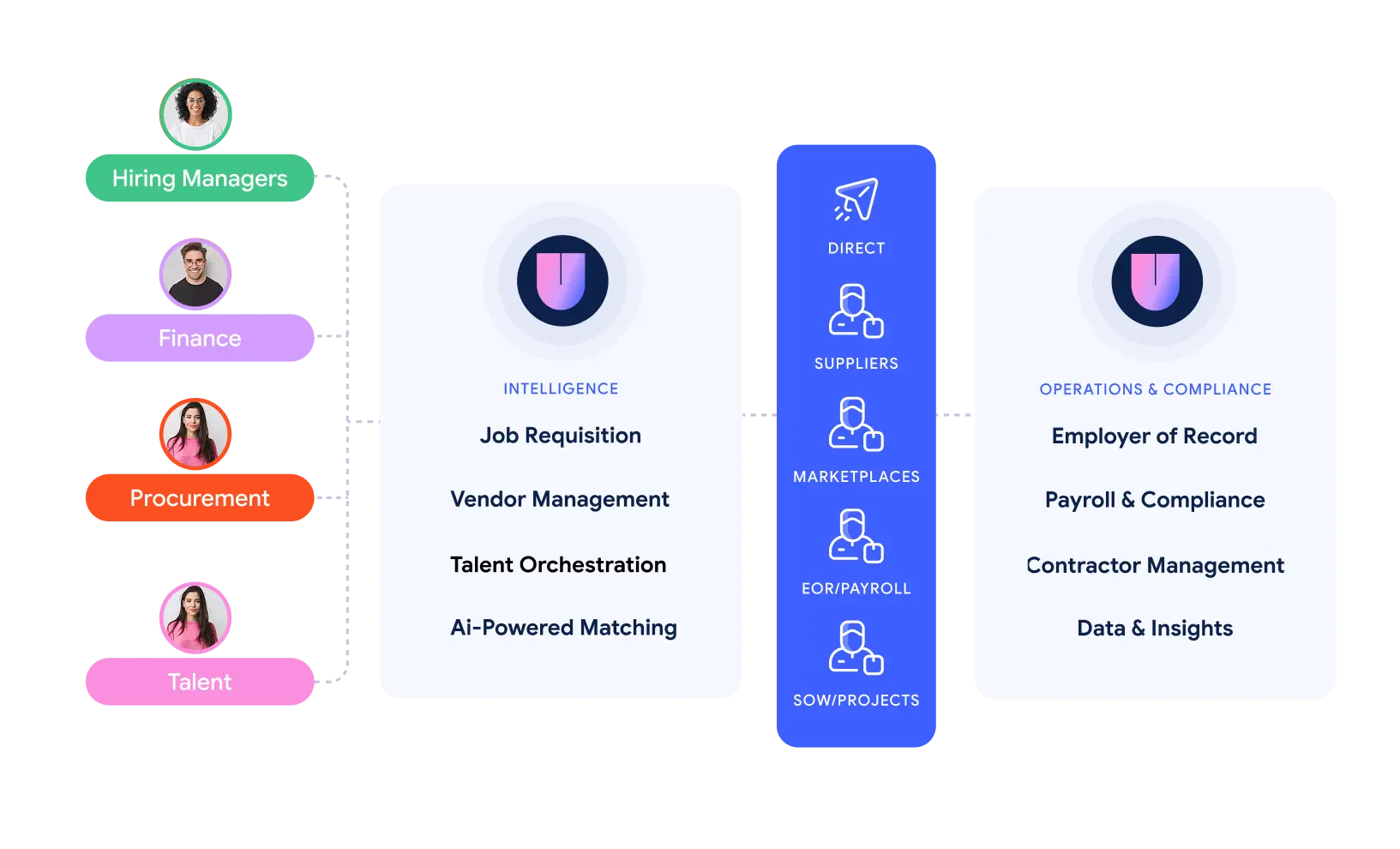
What customers are achieving with Upplft

Faster hiring, fewer breakdowns
Managers and suppliers move faster with standardised workflows, automation, and clear approvals — reducing time to hire without increasing risk.
Self-service with governance built in
Teams can engage contingent talent confidently while policies, approvals, and compliance controls are applied automatically in the background.
Greater impact from central teams
HR, Finance, and Procurement spend less time chasing data or fixing issues, and more time on workforce strategy and optimisation.

“Upplft puts contingent workforce control where the work happens.”

Impact highlights:
Clear visibility across contingent headcount and spend
Fewer exceptions and manual interventions
Faster onboarding and pay cycles
Stronger compliance and audit readiness
"Lorem ipsum dolor sit amet, consectetur adipiscing elit. Suspendisse varius enim in eros elementum tristique. Duis cursus, mi quis viverra ornare, eros dolor interdum nulla, ut commodo diam libero vitae erat."

Built for enterprise reality
Upplft is designed to work within complex environments and existing ecosystems:


Insights to help you scale your experience

Ready to start managing your contingent workforce?
Tell us what you’re after and the team will be in touch ASAP.
See Upplft in action.Add more copy to balance
FAQs
Lorem ipsum dolor sit amet, consectetur adipiscing elit. Suspendisse varius enim in eros elementum tristique.
Orchestration means coordinating systems, suppliers, workflows, and data across the entire contingent workforce lifecycle. Upplft acts as the control layer that connects existing tools and enforces consistent processes, rather than replacing them.
A VMS typically manages a single part of the contingent lifecycle, often focused on supplier engagement or rate cards. Upplft operates above VMSs as a system of record and control layer, orchestrating multiple systems, suppliers, and workflows end to end.
No. Upplft complements MSPs by providing a consistent operating model, shared data, and embedded governance across clients, suppliers, and regions. MSPs continue to deliver services, while Upplft provides structure and visibility.
Upplft integrates with payroll providers, VMS platforms, finance systems, HR systems, and supplier tools. Where specialist systems already exist, Upplft connects to them. Where manual coordination creates cost and risk, Upplft orchestrates the process.
Yes. Upplft provides a single system of record for contingent workforce data, including worker profiles, engagements, suppliers, approvals, compliance status, and cost. This enables consistent reporting and governance across the lifecycle.
Upplft prevents cost leakage by standardising workflows, embedding approvals and policy into process, and aligning workforce data with financial reporting. Cost is controlled before spend occurs, not reconciled after the fact.
Compliance requirements such as right-to-work checks, background screening, health and safety, and policy approvals are built directly into workflows. This ensures requirements are met consistently across regions and engagement types.
Yes. Upplft supports contingent workers and can provide unified visibility across permanent, fixed-term, and flexible workforce types to help organisations understand and manage their overall workforce mix.
Implementation is phased and designed to work alongside existing systems. Most organisations begin seeing value once core workflows and integrations are live, without needing to pause current operations.
Adoption is driven through role-based experiences that guide users through the right process. By embedding policy into workflows and reducing manual effort, compliant behaviour becomes the easiest option.